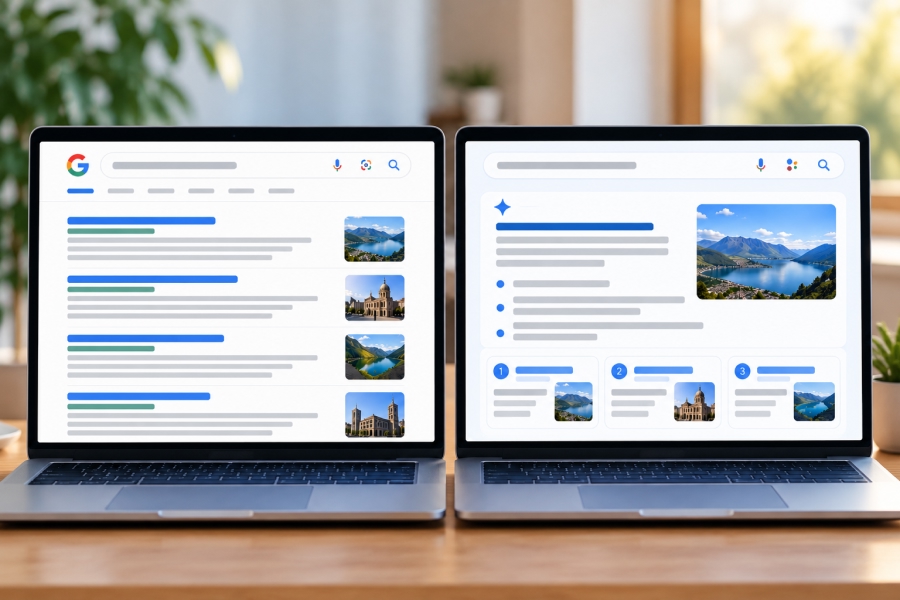
AI Search vs Traditional SEO: The Mid-Year Reality Check — What’s Actually Changed Since Spring 2026

Back in February, we wrote about how AI-generated search results were starting to change the rules for small business SEO. Five months in, it’s worth a real check-in: what’s actually held up, what’s shifted faster than expected, and what a business owner should be doing differently right now. Some of what we predicted played out about as expected. Other parts of the landscape moved faster than almost anyone in the industry anticipated. Here’s the honest mid-year read, and what it means for the rest of 2026.
AI-Generated Answers Are Showing Up More Often
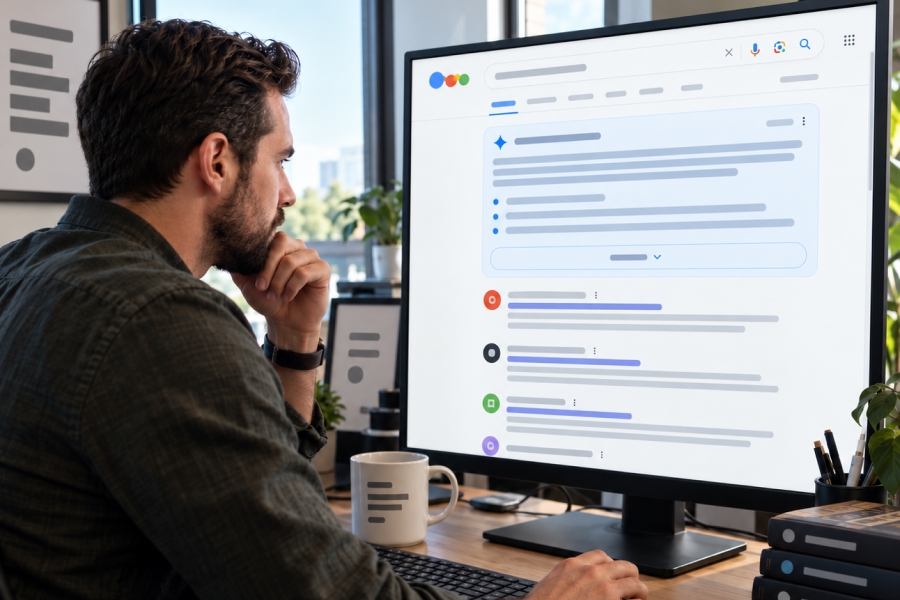
This is the piece that moved fastest. In February, AI-generated answers were common but far from universal. By mid-summer, they’re the default starting point for a large and growing share of everyday searches, and Google hasn’t slowed down the rollout.
- Google’s AI-generated answers, AI Overviews and the newer AI Mode, now appear for a much larger share of everyday searches than they did at the start of the year, and coverage keeps expanding into new query types and markets.
- Google gave its search box a major redesign this year, built to handle longer, more conversational, multi-part questions rather than short keyword phrases.
- Voice search and typed search are converging. People increasingly type full questions the way they’d ask a person, not the clipped keyword phrases that used to define search behavior.
- Practical effect: if you’re still writing content around short two- or three-word keywords, you’re optimizing for how people searched two years ago, not how they’re searching now.

Ranking #1 No Longer Guarantees You Get Cited
- Being cited inside an AI-generated answer has become its own outcome, separate from your position in the traditional list of blue links. A page can rank well and still get left out of the AI summary, while a page further down the results gets quoted directly.
- Which sources get cited has broadened well beyond the traditional top ten results. Content structure, clarity, and demonstrated topical authority now carry real weight alongside ranking position.
- Google’s own guidance to site owners hasn’t changed the fundamentals: there’s no separate checklist for AI features on Search, just a reminder that the same SEO basics, useful content, clear structure, and technical health, now feed both the traditional results and the AI layer on top of them.
What This Means If Most of Your Traffic Comes from Local Search
- Local, near-me style searches are increasingly answered directly, pulling from the same signals that already drive your placement in the local map pack.
- The fundamentals matter more, not less: a fully filled-out Google Business Profile, accurate categories, steady reviews, and consistent business listings across the web.
- Two habits worth retiring: stuffing Google Business Profile posts with repeated keywords, and renaming photo files for SEO instead of naming them for what they actually show. Neither has a track record of helping in the current environment, and both eat time better spent elsewhere.
The short version for local businesses: nothing about the underlying strategy changed, but the stakes did. A profile that used to be “good enough” for the map pack now also feeds the AI answer sitting above it. Gaps that were minor a year ago are more visible today.
How This Compares to What We Said in February
It’s worth being direct about what our earlier article got right and where the landscape moved faster than expected.
- What held up: the shift toward AI-generated answers was real and not a passing trend. Businesses that started building topical authority and cleaning up their profiles back in February are in a stronger position today than businesses that waited.
- What moved faster than expected: the sheer scale of the rollout. AI-generated answers went from a notable feature to the default search experience for a large share of queries in a matter of months, not years.
- What’s genuinely new since February: dedicated Search Console reporting for AI features, a redesigned search box built around conversational queries, and citation patterns that have started to stabilize instead of shifting week to week.
A New Tool Worth Knowing About
- In June, Google added a dedicated report inside Search Console that shows how your site performs specifically within AI Overviews and AI Mode, broken out by page, country, device, and date.
- For business owners, this is the first real window into whether AI search is actually sending you traffic, rather than guessing based on a drop in overall click numbers.
- It shows which of your pages appeared inside an AI-generated answer, broken out by country, device, and date, so you can see the trend over time instead of a single snapshot.
- If you’ve already worked through our Search Console and Analytics walkthrough, this new report sits right alongside the ones you’re already checking. Give it a look before you assume a traffic dip means something is broken. It may just mean the click happened inside the AI answer instead of on your page.

What Actually Helps a Page Get Cited
- Lead with a clear, direct answer near the top of a section instead of building up to it. AI systems tend to pull the sentence that most directly answers the question.
- Add basic structured data for FAQs and business information where it applies. It helps machines confirm what a page is actually about.
- Build genuine topical authority over time with a few connected pages on a subject rather than a single one-off post. Consistency is being rewarded more than volume.
- Keep the technical basics healthy: fast-loading pages, mobile-friendly design, and a site that’s easy to crawl. AI features still draw on the same underlying search index and quality systems as everything else.
Do You Still Need Traditional SEO?
This is the question we hear most often, and the honest answer is yes. AI-generated answers still draw on the same underlying search index and the same core ranking systems that have always mattered. A site with weak technical SEO, thin content, or a confusing structure isn’t going to perform better in an AI answer than it did in a traditional result. If anything, the bar for content quality has gone up, not down, because AI systems are more selective about what they’re willing to cite. Think of AI search as a new layer sitting on top of traditional SEO, not a replacement for it.
What We’re Seeing With Our Own Clients
Clients who kept their Google Business Profile current and restructured their content into clear, answer-first sections have generally held or grown their visibility this year, even as raw click volume has shifted for everyone. Visitors who do click through from an AI-cited result or answer also tend to arrive with a clearer idea of what they want, which typically makes for a better-qualified lead. The businesses that have struggled most are the ones that made no changes at all, and are now comparing this year’s traffic to last year’s without accounting for how differently people are searching.
What to Actually Do About It for the Rest of 2026
- Check the new AI Overviews and AI Mode report in Search Console before assuming why your traffic moved.
- Review your Google Business Profile for gaps: categories, hours, services, and recent photos.
- Pick two or three of your best-performing pages and restructure them so the direct answer appears early, then add supporting detail underneath.
- Add simple FAQ sections to key service pages, written the way a customer would actually ask the question.
- Revisit this again toward the end of the year. This is still a fast-moving area, and what’s true in December may look different from what’s true today.
- Skip the one-off “AI SEO hack” tactics that show up in your inbox. The businesses holding steady are the ones investing in the same fundamentals, applied a little more deliberately.
The Bottom Line
- AI search hasn’t replaced traditional SEO, it’s layered on top of it. The businesses adapting well are treating this as an evolution of SEO fundamentals, not a reason to start over. If you’d like a second set of eyes on where your site stands in this new landscape, get in touch with Moore Tech Solutions for a free AI features consultation.
This article is for informational purposes only and is not a guarantee of results. Search visibility, including performance within AI-generated search features, varies by market, industry, competition, and implementation. Contact a qualified digital marketing professional for guidance specific to your business situation.
Donald B. Moore
Donald B. Moore is the founder of Moore Tech Solutions, Inc., where he has spent over two decades helping businesses grow online. With deep expertise in web solutions, Don combines technical precision with a marketer’s eye for results. He has helped clients nationwide, delivering results that are strategically optimized for visibility and conversion. Through his posts, Don shares practical insights drawn from years of hands-on problem-solving, empowering readers to make informed, impactful decisions about their online presence.