SEO vs. AI SEO: What’s Changed—and What Still Matters?
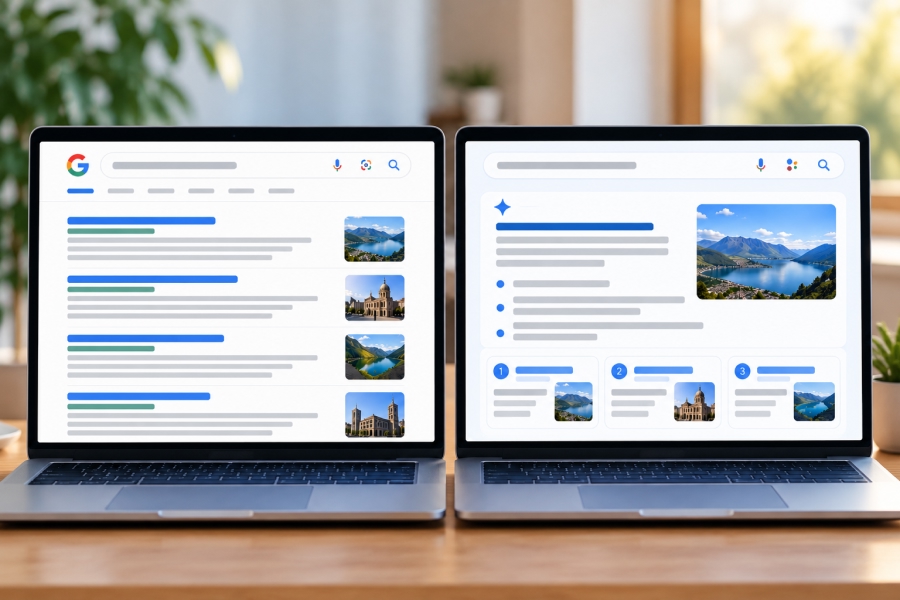
AI search has changed how people ask questions and how answers reach them. A customer may still type a short phrase into Google and choose from a page of links. The same customer may also ask ChatGPT to compare several businesses or read an AI-generated summary directly in Google.
That shift has led to a predictable question: Is traditional search engine optimization still relevant, or does every business now need a separate AI SEO strategy?
Traditional SEO remains the foundation. AI SEO expands the work by considering whether AI systems can understand, cite, and recommend a business or its content. Our complete guide to AI SEO explains the broader discipline. This article focuses on what has actually changed and which long-standing practices still carry the most weight.
What Traditional SEO Is Designed to Do
Traditional SEO helps search engines discover a website, understand its pages, and decide when those pages are relevant to a search. The familiar goal is visibility in standard results, map listings, image results, product results, or other search features.
Google’s SEO Starter Guide still centers on practical fundamentals: organize a site clearly, help Google find and understand the content, use descriptive language, provide a good page experience, and create information that serves readers.
Traditional SEO also helps a business connect pages with the searches customers use. A plumber may optimize service and location pages for water-heater repair in Birmingham. A dentist may publish a detailed page about dental implants. A financial advisor may explain retirement planning for business owners.
Those pages remain useful because AI systems still need accessible, relevant information. The destination has expanded, but the underlying material has not disappeared.

What AI SEO Adds
AI SEO looks beyond whether one page ranks for one keyword. It considers whether a search or answer system can extract the right facts, connect them with a detailed question, compare them with other sources, and use them in a response.
A traditional search might be “HVAC company near me.” An AI-assisted request may be much more specific: “Which HVAC companies near Birmingham install high-efficiency heat pumps, offer financing, and have experience replacing older systems?”
The second request contains several conditions. A business may be a good match, but the system needs enough accurate information to identify that match. This is where service details, location information, FAQs, project examples, reviews, business profiles, and credible third-party references become especially useful.
What Has Changed
Searches Are Becoming More Conversational
OpenAI explains that ChatGPT search may rewrite a question into one or more targeted searches and may run additional searches as it develops an answer. A customer no longer has to reduce a complicated need to two or three keywords.
Keyword research still matters, but businesses can also study the full questions customers ask before calling, buying, scheduling, or requesting a quote. Those questions often reveal the comparisons, concerns, and qualifications that should be addressed in the content.
A Page Can Become Part of the Answer
Traditional search commonly presents links and asks the user to choose where to go next. AI search can summarize information before the user visits a website. A page may be cited as a supporting source, used to verify a fact, or help an AI system understand which businesses fit a request.
Google says that AI Overviews and AI Mode can use a technique called query fan-out, issuing multiple related searches across subtopics and data sources. Its guidance for AI features in Search also states that pages must meet the usual technical requirements for Google Search. No special AI file or schema markup is required.
This creates a wider set of opportunities. A page does not always have to be the single highest-ranking result for a broad phrase to contribute something useful to a more specific AI-generated answer.
Clarity Matters More Than Marketing Language
Phrases such as “exceptional solutions,” “industry-leading service,” and “committed to excellence” say very little about whether a business fits a customer’s request. AI systems work more effectively with concrete facts: what the company does, who it serves, where it operates, what qualifications it holds, and which problems it handles.
Clear writing has always helped SEO. AI search makes the cost of vague writing easier to see because a system cannot confidently use details the business never provides.
Authority Extends Beyond Your Website
A company’s website is one source of information about the business. Search and AI systems may also encounter business profiles, reviews, professional associations, news coverage, directories, social profiles, and other third-party references.
These sources do not create a guaranteed recommendation. They can help confirm that the company exists, operates where it claims, provides the listed services, and has relevant experience. Consistent information across the web reduces uncertainty for customers and machines.
Measurement Is Broader Than Rankings
Rankings, organic traffic, leads, and conversions remain important. AI visibility adds other questions: Is the company mentioned? Which pages are cited? Are the facts accurate? Which competitors appear? What sources seem to influence the answer?
AI responses can vary with wording, location, timing, and conversation context, so one prompt is not a permanent ranking report. Businesses can learn more by testing a small, consistent set of realistic questions and watching for patterns.

What Still Matters
Crawling and Indexing
Search systems cannot make full use of pages they cannot access. Robots.txt rules, noindex directives, broken internal links, server errors, firewall settings, and JavaScript-dependent content can still prevent discovery.
Different systems may use different crawlers. OpenAI identifies OAI-SearchBot as the crawler used for ChatGPT search, while Google relies on its own crawling and indexing systems. Technical SEO remains the first eligibility check.
Useful Content
Google continues to recommend helpful and reliable people-first content. AI has not changed the value of answering a customer’s question accurately and completely. It has made generic content easier to produce, which gives original experience and specific information more room to stand out.
Useful content may include clear service explanations, real examples, local knowledge, comparisons, case studies, original photos, expert review, or data gathered through the business’s own work. Length alone does not create value.
Site Structure and Internal Links
A logical site structure helps visitors and crawlers understand how topics relate. Service pages, location pages, articles, staff profiles, and supporting resources should connect naturally rather than sit as isolated pages.
That same principle supports an AI SEO content strategy. A strong central guide can introduce a broad topic, while focused cluster articles answer the narrower questions that arise from it.
Reputation and Credibility
Backlinks, legitimate reviews, accurate business listings, industry relationships, and third-party mentions still help establish credibility and discovery. The goal is not to collect mentions from any site willing to publish one. Relevant sources that customers would reasonably trust are more useful.

Page Experience
People still visit websites after seeing a search result, citation, or recommendation. Slow pages, confusing navigation, intrusive popups, unreadable mobile layouts, and unclear contact options can waste the visibility a business worked to earn.
AI search may change the path to the website. It does not remove the need for the website to answer questions and help the visitor take the next step.
How Businesses Can Adjust
Most businesses do not need to replace their SEO program with a separate collection of AI tactics. A practical adjustment is to review existing work through a broader set of questions:
- Can search engines and relevant AI crawlers reach the important pages
- Does the website state services, locations, qualifications, and limitations clearly
- Does the content answer the detailed questions customers ask during a decision
- Does the business provide information or experience worth citing
- Are key facts consistent across the website and major third-party sources
- Are traditional search performance and AI visibility both being monitored
The answers can help determine whether the priority is technical cleanup, clearer service content, stronger supporting articles, better local information, reputation work, or improved measurement.
SEO and AI SEO Work Together
Traditional SEO and AI SEO are not competing disciplines. Traditional SEO builds the technical, content, and authority foundation. AI SEO applies that foundation to search experiences that summarize, compare, cite, and recommend.
The most durable strategy serves both people and machines: publish accurate information, organize it clearly, support it with evidence, and keep it accessible to the systems customers use to search.
Moore Tech Solutions has helped businesses improve their websites and search visibility since 2004. If you would like to evaluate how your current SEO strategy supports both conventional search and AI-powered discovery, contact Moore Tech Solutions to discuss your website and goals.
This article is for informational purposes only. Results from web design, SEO, and digital marketing services vary based on market conditions, industry, competition, and implementation. Contact a qualified digital marketing professional for guidance specific to your business situation.
Donald B. Moore
Donald B. Moore is the founder of Moore Tech Solutions, Inc., where he has spent over two decades helping businesses grow online. With deep expertise in web solutions, Don combines technical precision with a marketer’s eye for results. He has helped clients nationwide, delivering results that are strategically optimized for visibility and conversion. Through his posts, Don shares practical insights drawn from years of hands-on problem-solving, empowering readers to make informed, impactful decisions about their online presence.